

Corporate Thanksgiving Gifts: Tax & Accounting Rules Every Business Should Know
Corporate Thanksgiving Gifts: Tax & Accounting Rules Every Business Should Know
Explore GiftsKey Takeaways
- Thanksgiving corporate gifts can be tax deductible, but IRS rules limit deductions to $25 per recipient per year for business gifts.
- Physical gifts like chocolates are generally more tax-friendly than cash or gift cards, which are treated as taxable income.
- Employee Thanksgiving gifts may qualify as de minimis benefits if they are low-value and infrequent.
- Proper documentation and accounting classification are essential to avoid issues during audits.
-
Thoughtful, branded gifts can balance employee appreciation, client relationships, and tax compliance effectively.
Why Thanksgiving Gifting Needs Financial Clarity
Thanksgiving corporate gifts are more than a seasonal gesture—they’re a business decision that blends appreciation, branding, and financial responsibility. For companies gifting employees, clients, or partners in the United States, Thanksgiving sits at a unique intersection of gratitude and governance. While the intent is warm, the implications around tax deductibility, accounting classification, and compliance are anything but simple.
Many business buyers assume that all Thanksgiving gifts qualify as straightforward write-offs. In reality, IRS rules around business gifts, employee benefits, and promotional expenses are nuanced. A beautifully curated chocolate gift box may strengthen relationships—but how it’s recorded in your books can impact audits, payroll reporting, and year-end tax planning.
This is why understanding the tax and accounting side of Thanksgiving gifting is essential before placing bulk orders from a provider like Thanksgiving corporate gifts. When done thoughtfully, corporate Thanksgiving gifting can be compliant, deductible, and deeply meaningful—similar to how Indian businesses approach Diwali gifting with both emotion and structure.
In this guide, we break down the tax rules, accounting principles, and best practices every corporate buyer should know before sending Thanksgiving gifts.
-----------------------------------------------------------------------------------------
Thanksgiving Gifting in the Corporate World: Context & Background
Thanksgiving holds a special place in US business culture. Unlike promotional-heavy holidays, Thanksgiving is rooted in appreciation—making it an ideal moment for employee recognition and client relationship-building. Companies often use this period to reinforce values of gratitude, loyalty, and partnership ahead of year-end closures.
However, corporate Thanksgiving gifts are not treated the same as marketing campaigns or performance bonuses. From an accounting perspective, these gifts may fall into different categories:
- Business gifts to clients
- Employee fringe benefits
- Promotional or advertising expenses
Each category carries distinct tax implications.
For example, gifting a box of branded chocolates to a long-term client may qualify under business gift deductions, while the same box sent to an employee could be considered taxable compensation unless it meets “de minimis” criteria. This distinction is critical for HR, finance teams, and procurement managers coordinating large-scale gifting programs.
As companies increasingly opt for customized, logo-printed, edible gifts—like personalized chocolate boxes presented in premium packaging—the need for clarity has grown. Brands such as ChocoCraft operate at this intersection, where personalization, presentation, and compliance must work together seamlessly across corporate gifts, corporate gifts for employees, and corporate gifts for customers.
Understanding the “why” behind tax rules helps businesses gift confidently—without surprises during audits or payroll reconciliation.
Thanksgiving Corporate Gifts
Celebrate gratitude with personalized chocolate gifts crafted for your clients and teams.
Shop Now-----------------------------------------------------------------------------------------
Why Thanksgiving Gifting Often Creates Tax Confusion
The biggest challenge with Thanksgiving corporate gifts is not generosity—it’s classification.
Many businesses ask:
- Are Thanksgiving gifts tax deductible?
- How much can a company write off for client gifts?
- Are employee Thanksgiving gifts taxable income?
The confusion stems from three realities:
1. The IRS Gift Deduction Limit Is Surprisingly Low
The IRS generally allows businesses to deduct up to $25 per recipient per year for business gifts. This limit has remained unchanged for decades, despite rising costs. For premium Thanksgiving gifts, this often surprises decision-makers.
According to IRS Publication 463, the $25 cap applies to the value of the gift itself—not incidental costs like shipping or packaging, if they don’t add substantial value.
2. Employees and Clients Are Treated Differently
Client gifts fall under business gift deductions. Employee gifts, however, may be classified as taxable wages or de minimis fringe benefits (very low value, infrequent gifts).
Even a well-intended Thanksgiving chocolate box can become taxable if it doesn’t meet de minimis standards.
3. Branded Gifts Blur the Line Between “Gift” and “Advertising”
If a Thanksgiving gift prominently features your logo and is distributed widely, parts of the cost may qualify as promotional expenses instead of gifts—changing how it’s recorded in accounting.
As noted by Forbes Finance Council, businesses often miss opportunities to optimize deductions simply because gifts aren’t categorized correctly.
Choose gifts that reflect your brand values. Read more →
-----------------------------------------------------------------------------------------
How Thanksgiving Corporate Gifts Are Taxed & Accounted For
1. Business Gift Deduction Rules (Clients & Partners)
Under IRS guidelines:
- Only $25 per person per year is deductible for business gifts
- The limit applies per recipient, not per gift
- Cash or cash equivalents (like gift cards) do not qualify as deductible gifts
However, incidental costs—such as decorative packaging, delivery, and handling—may be deducted separately if they don’t significantly increase the gift’s value.
This matters for premium edible gifts. A personalized chocolate box with elegant outer packaging may exceed $25 in total cost, but part of that spend may still be deductible when categorized correctly, as clarified in IRS Business Gift FAQs.
2. Employee Gifts & De Minimis Fringe Benefits
Employee Thanksgiving gifts are often misunderstood. According to IRS guidance on de minimis fringe benefits, small, infrequent, non-cash gifts may be excluded from taxable income.
This distinction is especially relevant for HR teams aligning gifting policies with HR guidelines for Thanksgiving gifts and MNC Thanksgiving policies.
Recommended Reading
-----------------------------------------------------------------------------------------
Data, Research, and Real-World Insights on Thanksgiving Corporate Gifting
Tax and accounting rules may sound theoretical until businesses experience their real-world impact. Finance leaders frequently point out that gifting-related audit flags often arise not from overspending, but from unclear documentation and misclassification.
According to IRS guidance outlined in Publication 463 on Travel, Gift, and Car Expenses, the most common compliance issues involve improper deduction amounts and lack of recipient-level tracking. In practice, this means businesses that send Thanksgiving corporate gifts in bulk without mapping recipients risk losing deductions entirely.
Business publications echo this concern. A Forbes Finance Council article explains that companies often fail to separate gift value from incidental expenses such as shipping and premium packaging, resulting in missed deductions even when the gifting itself is compliant (Forbes Finance Council).
From an accounting perspective, this is where edible, personalized gifts offer an advantage. Unlike cash or gift cards, physical items such as chocolates can be clearly categorized, valued, and documented. Many businesses choose branded consumables because they reduce ambiguity while delivering genuine appreciation.
This is also why organizations increasingly rely on structured gifting programs—similar to how enterprises approach year-end or company holiday gifts—rather than ad-hoc purchases.

-----------------------------------------------------------------------------------------
Practical How-To: Making Thanksgiving Corporate Gifts Tax-Smart
For buyers responsible for procurement, HR, or finance, the goal is not just to gift—but to gift wisely. Below is a practical framework businesses can follow to align Thanksgiving gifting with tax and accounting best practices.
Step 1: Define the Recipient Category Clearly
Start by separating recipients into clear groups:
- Clients and external partners
- Employees (full-time, part-time, remote)
- Vendors or consultants
Each group is treated differently under tax rules. Client gifts fall under business gift deductions, while employee gifts may fall under taxable compensation unless classified as de minimis fringe benefits.
Step 2: Choose the Right Type of Gift
Thanksgiving gifts that work best from an accounting standpoint are:
- Physical, non-cash items
- Modestly priced per recipient
- Easy to document and value
- Universally appropriate
This is why many companies choose edible gifts such as customized chocolate boxes. Products like Happy Thanksgiving 4-Chocolate Gift Boxes or 6-Chocolate Thanksgiving Gift Boxes offer flexibility across budgets while remaining easy to account for.
Step 3: Track Costs the Right Way
Accounting teams recommend separating:
- Gift value
- Packaging and presentation
- Shipping and logistics
This allows businesses to apply the $25 gift deduction correctly while still deducting incidental expenses where permitted. Clear invoices and itemized billing from gifting partners simplify this process significantly.
Step 4: Align with Internal Policies
Large organizations often rely on internal policies to standardize gifting. If your company has formal guidelines, ensure Thanksgiving gifting aligns with:
Consistency across departments reduces compliance risk and improves employee and client experience.
Choose gifts that reflect your brand values. Read more →
-----------------------------------------------------------------------------------------
Budget-Based Gifting Without Compliance Stress
One of the smartest ways to stay tax-aware is to plan Thanksgiving gifting by budget tier. This approach mirrors how finance teams manage expense caps and simplifies approvals.
For example:
- Thanksgiving corporate gifts under $10 work well for large employee groups or remote teams.
- Gifts under $20 strike a balance between appreciation and scalability.
- Gifts under $30 are often used for valued clients or managers.
- Gifts under $40 allow for premium packaging and personalization.
- Gifts under $50 are typically reserved for key partners or leadership.
This tiered approach supports both compliance and thoughtful gifting—without creating friction during tax season.
Choose gifts that reflect your brand values. Read more →
-----------------------------------------------------------------------------------------
Trends and Expert Insights: Where Thanksgiving Gifting Is Headed
Industry experts consistently note a shift toward consumable, personalized, and policy-aligned corporate gifts. Harvard Business Review has highlighted that meaningful recognition often outperforms monetary incentives in strengthening workplace relationships.
From a tax and accounting standpoint, this trend aligns well with compliance. Physical gifts that are modestly priced, branded, and documented offer fewer ambiguities than cash-based rewards.
There is also growing emphasis on cultural sensitivity. Just as Indian companies treat Diwali gifting as a structured business ritual, US businesses increasingly view Thanksgiving gifting as a formal program rather than an afterthought.
Providers like ChocoCraft support this shift by offering customizable chocolate gifts that balance branding, appreciation, and operational clarity—without overwhelming the gifting narrative.
-----------------------------------------------------------------------------------------
Conclusion: Gratitude That’s Thoughtful, Compliant, and Impactful
Thanksgiving corporate gifts are not just about saying “thank you.” They are an opportunity to reinforce relationships, strengthen culture, and reflect financial discipline. When businesses understand tax rules, accounting treatment, and documentation requirements, gifting becomes a strategic asset rather than a compliance concern.
By choosing appropriate gift types, tracking costs carefully, and aligning with internal policies, companies can gift confidently—knowing their Thanksgiving gestures are both meaningful and responsible.
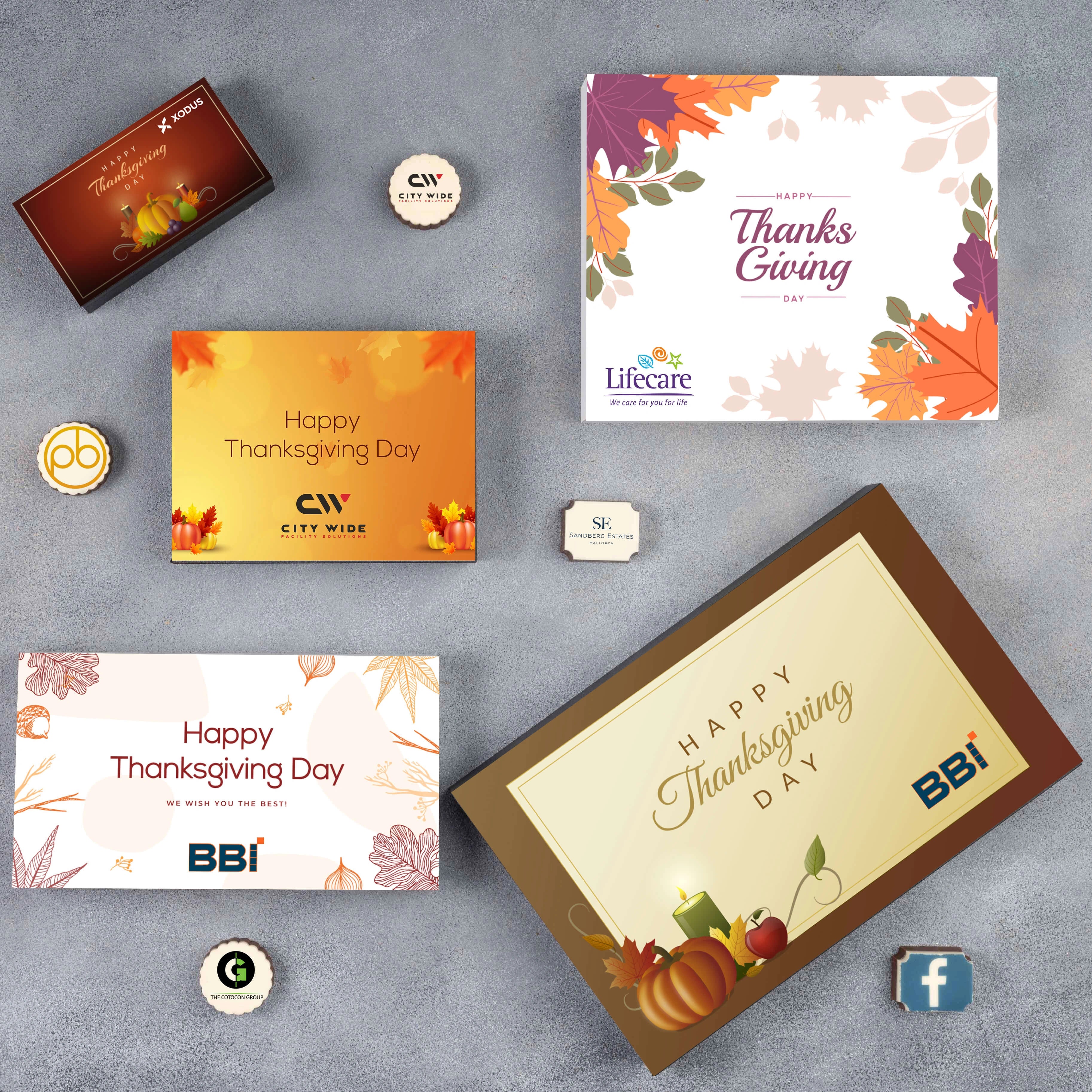
Thanksgiving Logo Chocolates
Strengthen relationships with beautifully branded chocolate gifts.
Gift NowIf you’re planning your next Thanksgiving gifting program, explore thoughtfully curated, customizable options that support appreciation without compromising compliance. When gratitude meets structure, everyone benefits.
-----------------------------------------------------------------------------------------
Key Information
| Aspect | Key Rule or Insight | Why It Matters |
|---|---|---|
| IRS Gift Deduction Limit | $25 per recipient per year | Prevents over-claiming deductions |
| Employee Gifts | May be taxable unless de minimis | Impacts payroll and reporting |
| Client Gifts | Deductible within IRS limits | Supports compliant client appreciation |
| Gift Cards | Treated as cash equivalents | Generally non-deductible and taxable |
| Food Gifts (Chocolates) | Physical, non-cash items | Easier to document and deduct |
| Branding on Gifts | May qualify as promotion | Can affect expense classification |
| Documentation | Recipient, cost, purpose required | Essential for audits and compliance |
-----------------------------------------------------------------------------------------
FAQs
1. Are Thanksgiving corporate gifts tax deductible for businesses?
Yes, Thanksgiving corporate gifts can be tax deductible, but with limits. The IRS generally allows businesses to deduct up to $25 per recipient per year for business gifts. Incidental costs like shipping or packaging may be deductible separately if they don’t add significant value.
2. How much can a company write off for Thanksgiving gifts to clients?
Businesses can typically write off up to $25 per client annually for Thanksgiving business gifts. This limit applies per recipient, not per gift. Additional costs such as delivery or custom packaging, may be deducted if properly documented and classified.
3. Are employee Thanksgiving gifts considered taxable income?
Employee Thanksgiving gifts may be taxable unless they qualify as de minimis fringe benefits. Small, infrequent, non-cash gifts—like modest food items—are often excluded from taxable income. Higher-value or recurring gifts may need to be reported as wages.
4. Are food gifts like chocolates tax deductible for Thanksgiving?
Yes, physical food gifts such as chocolates can be tax deductible when given as Thanksgiving corporate gifts. They are generally easier to classify and document than cash or gift cards, which are not deductible as business gifts under IRS rules.
5. Do branded Thanksgiving gifts qualify as advertising expenses?
In some cases, branded Thanksgiving gifts may qualify as promotional or advertising expenses rather than business gifts. If the branding is permanent, the cost is modest, and the items are distributed widely, parts of the expense may be treated differently for accounting purposes.
6. What documentation is required for Thanksgiving business gifts?
To stay compliant, businesses should document the gift’s cost, date, recipient, business purpose, and relationship to the company. Separating the value of the gift from incidental expenses like packaging or shipping helps support deductions during audits or tax reviews.
7. Are gift cards allowed as Thanksgiving corporate gifts for tax purposes?
While gift cards are popular, they are not considered deductible business gifts under IRS rules. Gift cards are treated as cash equivalents, making them taxable to employees and non-deductible for client gifting, unlike physical items such as branded chocolates or gift boxes.
8. How should companies account for bulk Thanksgiving gifting?
Companies should track Thanksgiving gifts at the recipient level, even when purchased in bulk. Proper accounting includes itemized invoices, recipient lists, and expense categorization. This approach helps ensure compliance and prevents deductions from being disallowed during tax assessments.
9. What are the best Thanksgiving gifts from a tax and accounting perspective?
From a tax and accounting standpoint, the best Thanksgiving corporate gifts are physical, modestly priced, non-cash items that are easy to document. Edible gifts like chocolates are widely accepted, universally appreciated, and simpler to classify than monetary rewards.
10. How can businesses balance meaningful Thanksgiving gifts with compliance?
Businesses can balance appreciation and compliance by setting budget tiers, choosing tax-friendly gift types, and aligning with HR and finance policies. Planning Thanksgiving gifting in advance allows companies to show gratitude while staying within IRS guidelines and accounting best practices.
