

How Giveaway Gifts Impact Trade Show ROI

How Giveaway Gifts Impact Trade Show ROI
Explore Giveaway GiftsKey Takeaways
-
Trade show giveaways directly influence ROI when they are tied to conversations, not volume. Gated, intentional gifting consistently outperforms mass swag in lead quality and follow-up outcomes.
-
Higher-perceived-value giveaways reduce cost per qualified lead. Even if unit cost is higher, fewer low-intent leads improve overall trade show giveaway ROI.
-
Sensory and personalized giveaways create stronger brand recall. Items that engage taste, touch, or emotion are remembered long after the event ends.
-
Giveaways work best as conversation closers, not openers. Timing the gift after engagement increases impact and sales alignment.
-
The most effective exhibitors align giveaway value with deal value. ROI improves when gifting strategy mirrors the importance of the prospect.
Walk through any major trade show in the USA and you’ll notice one universal truth almost immediately: attention is the rarest currency on the show floor. Hundreds of booths compete side by side. Thousands of conversations happen simultaneously. Every brand is trying to communicate value in just a few seconds before an attendee moves on.
This is where giveaway gifts quietly—but powerfully—shape trade show marketing ROI.
When executed thoughtfully, giveaways are not “free stuff” or last-minute booth fillers. They are behavioral triggers that influence human decision-making. They stop foot traffic, open conversations, anchor memory, and extend brand presence long after the event ends. When executed poorly, however, giveaways do the opposite: they drain budgets, attract low-intent visitors, and inflate cost-per-lead numbers without improving pipeline quality.
For buyers evaluating corporate giveaway gifts for exhibitions, expos, and events, the real question is no longer whether giveaways should be used at trade shows. Instead, it has evolved into a more strategic concern: How do giveaway gifts actually impact ROI, and what separates high-performing strategies from wasted spend?
This guide breaks down the real impact of giveaways on leads, brand recall, and trade show ROI in the USA. It combines research, buyer psychology, and real-world event experience—including how premium, customized options such as branded chocolates can shift outcomes when they are used intentionally rather than indiscriminately.
Explore curated options designed specifically for exhibitions and trade shows here: giveaway gifts for expos, exhibitions, and trade shows
Stand out from competitors by choosing unique giveaway gifts that go beyond standard pens and notebooks. Read more →
The Economics of Trade Show ROI
Trade shows remain one of the most expensive marketing channels for businesses operating in the USA. Booth rentals, travel, accommodation, logistics, staffing, creative design, sponsorships, and promotional materials can quickly add up to a significant investment. Because of this, trade show marketing ROI is scrutinized far more closely than many digital channels.
Most exhibitors evaluate success using a familiar set of metrics: cost per lead, number of qualified conversations, meetings booked, pipeline influenced, and post-event follow-ups completed. While these metrics are important, they often fail to capture the influence of micro-interactions that happen in seconds but affect outcomes weeks later.
What is frequently underestimated is how small moments—a pause in walking, a smile during a conversation, or a tactile experience—compound into measurable business results. Trade shows are sensory environments, and human decision-making in these spaces is far from purely rational.
According to research from the Center for Exhibition Industry Research, attendees typically decide within seconds whether to stop at a booth. Visual design and messaging matter, but in crowded halls, a tangible incentive often becomes the final permission to engage. This is where event giveaway effectiveness plays a meaningful role.
A thoughtfully chosen giveaway acts simultaneously as a traffic magnet, a conversation opener, and a memory anchor after the event. In contrast, generic swag bowls placed at booth corners tend to attract people who never convert, distorting trade show giveaway ROI metrics and frustrating sales teams tasked with follow-up.
For additional perspective on this shift, read: Are trade show giveaways still effective?
Corporate Giveaway Gifts for Expo, Exhibition & Trade Shows
Attract attention and drive brand recall with premium corporate giveaway gifts featuring personalized chocolate branding for expos and trade shows.
Explore Giveaway Gifts NowCore Problem: Why Many Trade Show Giveaways Fail to Deliver ROI
Despite heavy investment and good intentions, many exhibitors leave trade shows feeling disappointed with results. The issue is rarely giveaways themselves—it is how they are planned and deployed.
Giveaways are treated as decorations rather than tools. In many cases, giveaways are selected late in the planning process based on leftover budget or availability rather than lead strategy. As a result, they look appealing but serve no measurable purpose.
Grab-and-go swag attracts the wrong audience. Low-cost, high-volume giveaways optimize for footfall rather than intent. While booth traffic may increase, lead quality often declines, pushing cost-per-acquisition higher instead of lower.
The gift has no meaningful connection to the brand. If a giveaway does not align emotionally or contextually with what the brand stands for, recall fades quickly. Attendees remember the item but forget who gave it.
There is no post-event memory trigger. Trade shows are overwhelming experiences. Without a memorable takeaway, even a good conversation becomes just one of many, buried beneath emails and meetings after the event.
This is why experienced exhibitors are shifting their mindset from asking “How many items can we give away?” to asking “What experience does this gift create, and who is it meant for?”
Related insight on avoiding common mistakes: when not to give giveaways at trade shows
How Giveaway Gifts Actually Drive Trade Show ROI
To understand the true impact of giveaways on leads and conversions, it helps to view ROI as a sequence rather than a single outcome. High-performing giveaway strategies influence four distinct stages.
Attention capture. Premium, visible giveaways signal value before a word is spoken. In a noisy exhibition hall, this initial pause is critical.
Conversation enablement. The most effective giveaways are earned, not taken. When a gift is presented after a brief exchange, it reinforces engagement rather than replacing it.
Memory and brand recall. Sensory experiences—especially taste and touch—outperform visual exposure alone. They create stronger memory encoding and emotional association.
Post-event action. A memorable giveaway improves email open rates, callback recognition, and response to follow-ups, directly influencing trade show marketing ROI.
Learn how giveaways can be used to start and deepen booth conversations: using giveaways to start conversations at booths
At ChocoCraft, this framework is why custom printed chocolates presented in premium boxes are used selectively at US expos—not as mass swag, but as high-impact touchpoints for qualified prospects, partners, and decision-makers.
View the broader corporate gifting range here: corporate gifts for business and events
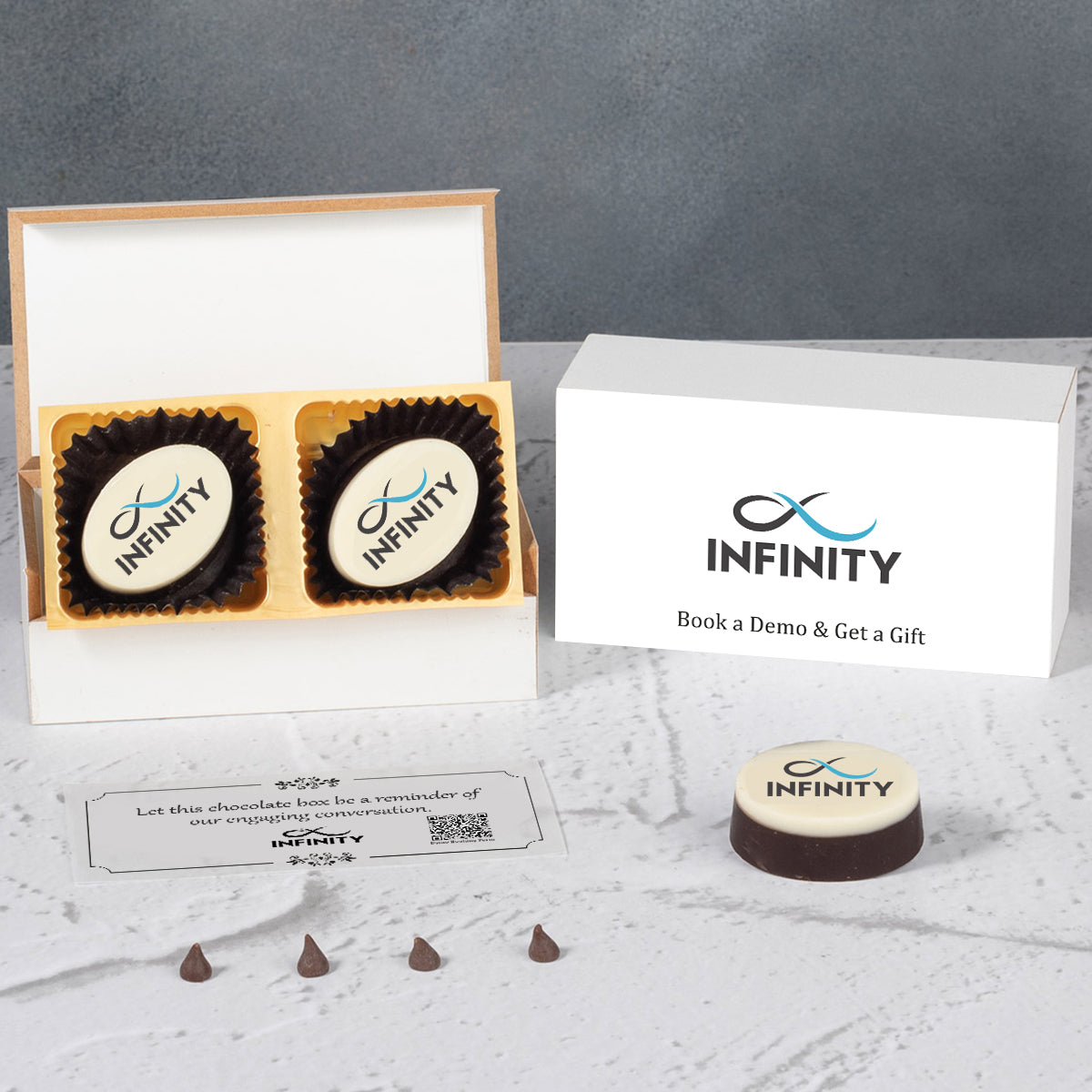
Book a Demo - Chocolate Box
📦 Box: Logo + “Book a Demo & Get a Gift”
📝 Message Inside: QR code linking to a demo booking form
🍫 Chocolates: One with “Demo” or calendar icon, one with logo
🎯 Purpose: Incentivizes visitors to book a demo, turning booth interest into qualified, scheduled leads.
Make it for your Brand
Data, Research, and Real-World Evidence: Proving Giveaway ROI
Trade show giveaways are often judged emotionally or anecdotally, but their true value becomes clear when viewed through data and observed behavior. In the USA, where trade show budgets are closely scrutinized, exhibitors increasingly rely on measurable indicators to justify giveaway investments.
Research from the Center for Exhibition Industry Research shows that attendees who actively engage with exhibitors are significantly more likely to remember the brand and take post-event action. Giveaways play a critical role in this engagement when they are connected to interaction rather than passive distribution.
Industry studies from the Promotional Products Association International consistently demonstrate that promotional items increase brand recall and favorability. The effect is stronger when the item is consumable, personalized, or emotionally engaging—factors that reduce the distance between attention and memory.
Harvard Business Review has also highlighted how sensory engagement improves memory encoding and decision confidence, particularly in environments with high cognitive overload such as trade shows. When multiple brands compete for attention in a limited time window, tactile and taste-based experiences help one interaction stand out from the rest.
In practical terms, exhibitors who gate giveaways behind conversations, reserve premium items for qualified prospects, and track post-event engagement signals tend to see a lower cost per qualified lead. Even when the per-unit cost of the giveaway is higher, overall trade show giveaway ROI improves because fewer low-intent leads enter the funnel.
For a broader discussion on measuring these outcomes, read: how giveaway gifts impact trade show ROI
Custom-branded giveaway gifts improve recall—your logo should feel integrated, not forced, into the product design. Read more →
Practical How-To: Maximizing Trade Show Giveaway ROI Step by Step
For buyers responsible for corporate giveaway gifts at exhibitions, expos, and events, maximizing ROI requires a structured approach rather than intuition alone. The following framework reflects what consistently works across US trade shows.
Step 1: Define the giveaway’s role clearly. Before selecting any item, decide what the giveaway is meant to achieve. Is it designed to attract initial booth traffic, reward meaningful conversations, improve post-event recall, or support relationship-building with high-value prospects? Each objective requires a different giveaway strategy.
Step 2: Align giveaway value with lead value. A common mistake is underestimating the lifetime value of a qualified lead. For B2B exhibitors with large deal sizes, a premium giveaway is often a cost-efficient investment rather than an unnecessary expense. Matching gift value to opportunity value helps protect trade show marketing ROI.
For guidance on allocating spend effectively, see: giveaway budget optimization for trade shows
Step 3: Use giveaways as conversation closers, not openers. High-performing booths rarely lead with giveaways. Instead, they introduce the gift after a short exchange, using it as a thank-you or reinforcement of the discussion. This approach ensures that the giveaway enhances engagement rather than replacing it.
Step 4: Create a post-event connection point. Simple techniques such as personalized messaging, QR codes on packaging, or follow-up references to the giveaway help link the booth interaction to later sales conversations. This is where event giveaway effectiveness translates into measurable outcomes.
Learn how giveaways can support better booth dialogue: how to use giveaways to start conversations at booths
Where Premium Edible Giveaways Fit into the ROI Equation
Edible giveaways occupy a unique position in trade show strategy because they combine immediacy with emotional engagement. Unlike desk items or printed collateral, consumables deliver value instantly and do not compete for long-term physical space.
Chocolates, in particular, perform well across industries because they are universally appreciated, easy to distribute selectively, and strongly associated with positive emotions. When customized with logos, messages, or names, they move from being promotional items to personal gestures.
This is why many exhibitors use premium edible giveaways selectively rather than at scale. They are often reserved for decision-makers, high-intent prospects, speakers, or partners—situations where relationship-building matters more than volume.
At ChocoCraft, exhibitors commonly match box size to interaction depth. Smaller chocolate boxes are used after brief but qualified conversations, while larger boxes are reserved for pre-scheduled meetings, partnerships, or strategic introductions.
Examples of commonly used formats include: 2 chocolate box corporate gifts, 6 chocolate box corporate gifts, 12 chocolate box corporate gifts
This intentional use helps maintain perceived value while protecting giveaway budgets.
For a deeper comparison, read: branding versus utility in trade show giveaways
Trends and Expert Insights Shaping Giveaway ROI
Several trends are influencing how giveaways impact trade show ROI in the USA, particularly as buyers become more selective and data-driven.
Fewer giveaways, stronger outcomes. Many exhibitors are reducing quantity while increasing relevance and perceived value. This shift reflects a move away from vanity metrics toward lead quality and conversion potential.
Personalization over logo saturation. Attendees respond more positively to gifts that feel contextual or personal rather than heavily branded. Names, messages, or event-specific references improve recall without overwhelming the recipient.
Greater compliance awareness. US venues increasingly regulate food items, materials, and distribution practices. Exhibitors who plan ahead avoid last-minute issues that can disrupt booth strategy.
Compliance considerations are covered in detail here: trade show giveaway compliance and venue rules in the USA
Sustainability as a credibility signal. While sustainability alone does not guarantee effectiveness, attendees appreciate it when it aligns authentically with brand values.
Related insight: do attendees care about sustainable giveaways

Product Highlight Chocolate Box
📦 Box: Logo with 2–3 key product images or category icons
📝 Message Paper: “Discover our full range at [website] | Visit us at Booth #42”
🍫 Chocolates: Product icons or category names (e.g., AI Tool, CRM)
🎯 Purpose: Showcases core offerings at a glance—turning a simple giveaway into a mini product sampler that drives deeper interest.
Make it for your BrandConclusion
Trade show giveaways do not inherently succeed or fail. Their impact depends on how intentionally they are selected, distributed, and connected to broader marketing goals.
When treated as strategic touchpoints rather than free handouts, giveaway gifts influence booth engagement, lead quality, brand recall, and post-event conversions. Aligning giveaway value with lead value, using gifts to enhance conversations, and choosing items that create emotional or sensory memory all contribute to stronger trade show marketing ROI.
In an increasingly competitive US trade show landscape, the brands that perform best understand one fundamental principle: the right giveaway does not end the interaction. It extends it.
For exhibitors exploring premium, customized giveaway gifts designed for exhibitions and trade shows, curated options can be viewed here: giveaway gifts for exhibitions, expos, and trade shows
For B2B audiences, premium giveaway gifts signal credibility and help position your brand as high-value and trustworthy. Read more →
Key Information
| Aspect | What It Means | Why It Matters for ROI |
|---|---|---|
| Giveaway Objective | Traffic, qualification, or recall | Prevents wasted spend on low-intent leads |
| Timing of Giveaway | After conversation, not before | Improves lead quality and engagement |
| Giveaway Type | Premium, relevant, or consumable | Increases brand recall and response rates |
| Distribution Strategy | Selective vs mass distribution | Lowers cost per qualified lead |
| Personalization | Logos, names, messages | Strengthens memory and brand association |
| Post-Event Link | QR codes, follow-up reference | Connects booth interaction to pipeline |
| Budget Alignment | Matched to deal size | Protects trade show marketing ROI |
FAQs
1. Do trade show giveaways really work anymore?
Yes, trade show giveaways still work when used strategically. Giveaways tied to conversations and lead qualification consistently improve engagement, recall, and follow-up rates. The key is moving away from mass swag and toward intentional, experience-driven gifting that supports trade show marketing ROI.
2. How do giveaways impact trade show ROI in the USA?
Giveaways impact trade show ROI by influencing booth traffic, lead quality, and post-event recall. In the USA, where trade shows are expensive, well-planned giveaways reduce cost per qualified lead and improve conversion rates by extending brand presence beyond the event.
3. Are expensive giveaways worth the cost?
Premium giveaways are often worth the cost when aligned with high-value prospects. While unit prices are higher, fewer low-intent leads enter the funnel, improving overall trade show giveaway ROI and reducing wasted follow-up effort.
4. What types of giveaways generate the best leads?
Giveaways that are relevant, personalized, and selectively distributed generate the best leads. Consumable or experience-based items often outperform generic swag because they create emotional engagement and stronger brand recall.
5. Should giveaways be given before or after conversations?
Giveaways are most effective when given after a conversation. This positions the gift as a reward or thank-you, reinforcing engagement rather than attracting people who are only interested in free items.
6. How do giveaways affect brand recall after trade shows?
Giveaways improve brand recall when they engage multiple senses or feel personal. Items that are memorable, useful, or enjoyable are more likely to be remembered during post-event follow-ups, directly supporting trade show marketing ROI.
7. Can giveaways reduce cost per lead at trade shows?
Yes, when giveaways are gated behind conversations and targeted at qualified prospects, they reduce cost per qualified lead. This improves efficiency even if overall giveaway spend remains the same.
8. Are edible giveaways effective for B2B trade shows?
Edible giveaways are highly effective because they create instant positive emotion and are universally accepted. When branded or personalized, they also reinforce recall without adding clutter to the attendee’s workspace.
9. How many giveaways should a booth plan for?
The right number depends on goals. High-performing booths plan fewer giveaways and distribute them intentionally. This approach prioritizes lead quality over quantity and protects trade show giveaway ROI.
10. How can exhibitors track giveaway effectiveness?
Effectiveness can be tracked using post-event engagement signals such as QR code scans, email response rates, meeting bookings, or references to the giveaway during follow-ups.
